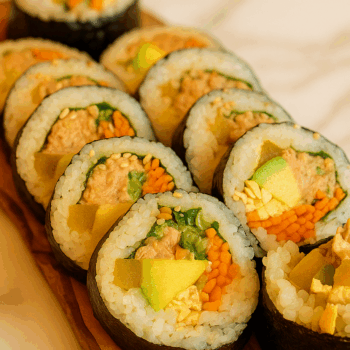
Tuna Avocado Kimbap
Ingredients
- 5 sheets Gimbap Gim Nori/Dried Seaweed (Using 1 and a half sheets per roll)
- 660 g Cooked Rice About 200-220g per roll
- 150 g Canned Tuna oil thoroughly drained
- 2 Tbsp Mayonnaise
- 1 Cheongyang Pepper Green chili (Optional)
- 1/4 Onion
- 1 Cucumber
- 1 Carrot
- 3-4 pieces Yellow Pickled Radish Danmuji
- 2 Eggs
- 3/4 Avocado
- 6 sheets Perilla Leaves Kkaennip (or 6 sheets of lettuce)
- Sesame Oil or Perilla Oil
- Salt
- Toasted Sesame Seeds Optional
Instructions
Cook the Rice. (Use Korean short-grain sticky rice.)
Prepare Vegetables.
- Julienne the cucumber, place it in a bowl, mix with a pinch of salt, and let sit for 20 minutes.
- After 20 minutes, squeeze the water out of the cucumber as much as possible.
- Julienne the carrot. Sauté the carrot in a dry pan with a pinch of salt. When cooked to your liking, finish by adding 1 teaspoon of Sesame Oil (or Perilla Oil).
- Whisk the eggs, season with 1/3 teaspoon of salt, and cook until golden brown in a pan with oil or butter.
- Once the eggs have cooled slightly, julienne them.
Prepare Fillings.
- Drain the tuna using a sieve to remove the oil as much as possible.
- Mix the drained tuna with 1 chopped Cheongyang pepper (optional), chopped onion, a dash of black pepper, and mayonnaise. Adding enough mayonnaise to make it nicely moist is delicious, but adjust to personal preference. You can also serve extra mayo as a dipping sauce.
- Slice the avocado lengthwise.
Season the Rice.
- To the slightly cooled rice, add 1/3 teaspoon of salt and 2 teaspoons of sesame oil per 220g (one roll's worth). Mix gently with a spatula. Do not mash the rice with your hands.
- Tip: Salt should be added incrementally until the rice is just a little bland, as all other ingredients are seasoned. For 3 rolls (660g rice): 1 teaspoon salt / 1.5 tablespoons sesame oil.)
Assemble the Huge Gimbap.
- Stick one and a half sheets of Gim together using water and a brush. The shiny side of the Gim should be facing outwards (down).
- Spread the seasoned rice as thinly as possible onto the Gim. (Fill the starting edge completely, and leave a 4-5cm gap at the finishing edge.)
- First, lay down the perilla leaves or lettuce barrier. (This prevents the moisture from the filling from soaking the rice, and it adds flavor.)
- Place the firmest fillings (like pickled radish) first at the bottom.
- Start placing the ingredients about 3-4cm from the edge closest to you.
Roll and Seal.
- No bamboo mat is needed. You can do this by hand.
- Roll the starting edge over the fillings, then use your fingertips to tuck the Gim in and gather the ingredients as you roll.
- Cup your hand around the ingredients to form a tight, solid bundle, and press down firmly. Hold for about 5 seconds.
- Wet the remaining end of the Gim with water and finish rolling to seal the seam.
- Leave the seam side down to stick well.
Slice.
- Slice the Kimbap. Use a saw-like motion when slicing the roll, but press down with force when you reach the final part to cut cleanly. (Note: Remember to oil your knife slightly before slicing!)
Video
Notes
[ TIPS ]
▶︎ Since all fillings are seasoned, only season the rice to be slightly bland.
▶︎ When rolling, press gently to gather and then hold firmly for about 5 seconds for a tight roll.
▶︎ Depending on the amount of filling you add, this recipe may yield 3 or 4 rolls.
▶︎ It's perfectly fine if you're missing some ingredients. You can still have delicious Gimbap even if you just stick to the eggs.